Will an 8K line-scan camera catch every tiny defect?
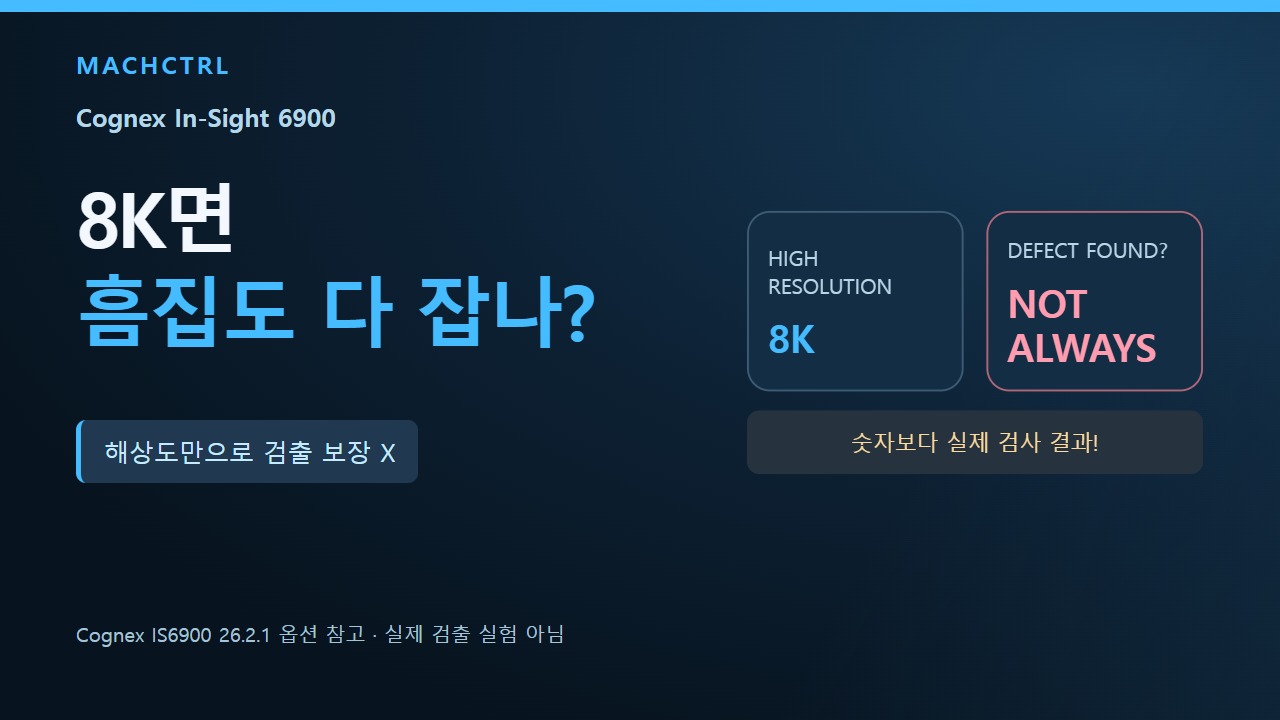
Imagine replacing a camera with a sharper one, then watching a fine scratch on a coating line pass unnoticed. Increasing pixel count alone does not automatically resolve lighting, focus, motion or decision-rule limitations.
What does line scan mean?
An area-scan camera acquires a two-dimensional image frame. A line-scan camera captures successive lines as the material moves, building an image across a continuous surface. That makes the technique useful for webs, rolls and coating processes.
The 4K and 8K descriptions refer to the pixel resolution across a line. At the same field of view, more pixels may resolve smaller cross-web differences. They do not, on their own, prove a higher real-world detection rate.
Four factors beyond the pixel count
- Lighting: A glossy surface can hide a scratch or create reflections that look like defects.
- Optics and focus: A high-resolution sensor cannot recover detail lost in an out-of-focus image.
- Web speed and exposure: The material's motion, line timing and available light affect the acquired image.
- Inspection rules: The feature must be visible and satisfy the configured detection and NG decision criteria.
As a hypothetical example, the same fine scratch might look different when the lighting angle changes, even with the same camera. This is an illustration, not a measured test result.
Here, NG means a rejected inspection result, PLC means a programmable logic controller, and line period is the interval between the starts of successive acquired lines.
A practical pre-upgrade checklist
- Define what is being missed. Record the defect types and acceptance thresholds.
- Calculate the image scale in millimeters per pixel (mm/pixel). Determine how much material each pixel represents instead of relying on “8K” alone.
- Test under production-like motion. Compare illumination, focus, exposure, line timing and encoder configuration at the intended web speed.
- Compare the decisions, not only the pictures. Use known good and known defective samples to check misses and false rejects, as well as PLC result mapping.
A few sample images do not establish performance across every product or lighting condition. Authorized, isolated trials with representative speed and material variation are still needed.
What Cognex actually announced
Cognex's In-Sight Vision Suite 26.2.1 October 2026 release lists new 4K and 8K monochrome line-scan camera options for the In-Sight 6900 Vision Controller. This is a product-specific option announcement—not evidence that every In-Sight model supports those cameras, that existing lines can be retrofitted without checks, or that coating-defect detection has been measured to improve.
Cognex's acquisition documentation also places model-specific constraints on the relationship between exposure time and line period for high-resolution 8K line scan. The real hardware, optics and operating speed must be checked before any configuration recommendation.
The takeaway: Before upgrading to 8K, find out why the current setup misses a known defect under real inspection conditions.
Primary sources and limits
- Cognex In-Sight Vision Suite v26.2.1 release
- Cognex v26.2.1 Acquisition Panel documentation
- Cognex In-Sight 6900 Reference Manual v26.2.0
Evidence limits: This educational article interprets manufacturer documentation. Examples are hypothetical, not measured tests on production equipment, databases or customer workspaces. It reports no measured detection, recovery or processing outcome. Operational changes require authorization and the documentation for the actual product and version.